Showing posts with label Pilots. Show all posts

Sunday, May 10, 2009

First 15 shipments

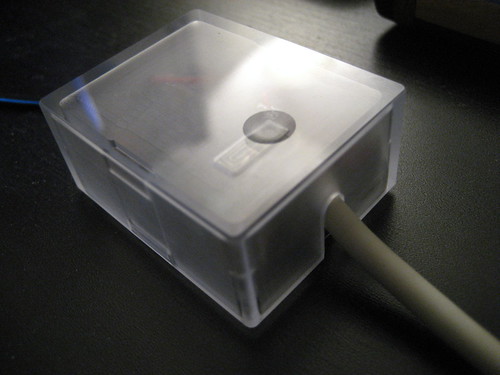
Thanks to everyone who made our first 15 deployments possible. Our peripherals are en route to Thailand, the United Kingdom, and Bolivia. Packaging these shipments, I had limited bubble wrap to secure the devices within the large boxes. However, the devices were more durable than I imagined and reached their destinations without any incidents. On the other hand, I'm not sure if the devices would survive a set of inquisitive and innocently destructive hands. As a result, we decided to build a protective cover. Thanks to Craig Lawson of Ideas Prototyped for his dedication! Craig and I have worked through a few iterations and developed a petite snap-fit cover that also fastens down the cables.


If you'd like to offer suggestions to our design, please contact me (tom.boonsiri@gmail.com).

Thursday, January 29, 2009

OLPC SB Collaboration

While we continue to press on with a deployment in Thailand, our chapter is more than happy to get involved with other US/domestic chapters. While there are certain challenges and restrictions to the introduction of new classroom material within certain public school systems, we are very appreciative of the bold educational pioneers who see the promise of our activity. Without their time and effort to integrate our material into their daily lesson plans, we would be without purpose.

On that note, I am glad to learn of the bold efforts of a teacher in Goleta, CA. With the aid of OLPC Santa Barbara, the teacher has secured the funding to deploy several XO laptops within his elementary school. Two weeks ago, I had an introductory conversation with OLPC Santa Barbara - External Collaborations representative Jonathan Kalan. Jon is playing a key role in the establishment of a Kenyan pilot (in fact in the same primary school which President Obama attended), but has been very receptive toward a near-term collaboration. As we complete our initial production of the IR sensor dongle, I aim to become more engaged with the Goleta pilot and assist Jon with another local deployment of our lesson plan. I look forward to the collaboration with the OLPC SB team which seems to be very education-heavy (Jon mentioned that their engineering team is in the early proces of recruitment). As a result, we can look forward to more detailed, constructive feedback from their team.

Our HW team continues to push towards a middle of February deadline. Meanwhile, I have recruited a Cambridge resident to help us with further abbreviation of our lesson plan. To our friends abroad, please send us a note if you are interested in samples of our bundle.

Stay tuned...

Thursday, June 19, 2008

Marin Middle School Demo

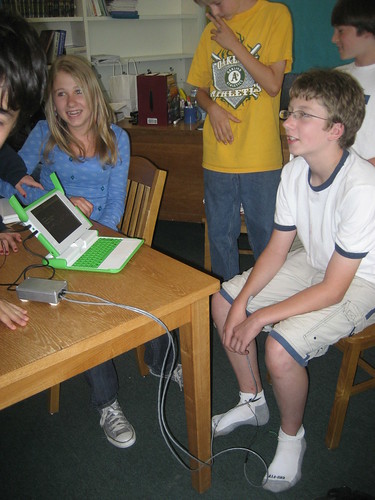
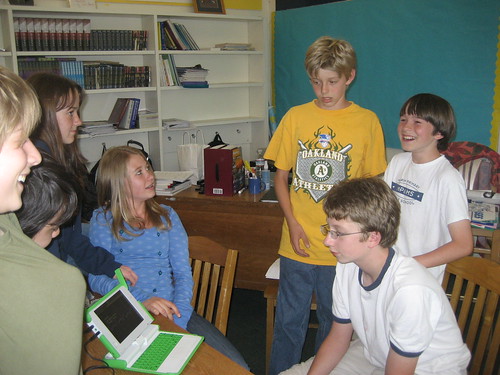
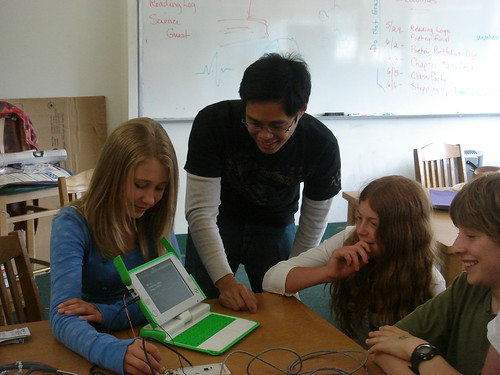
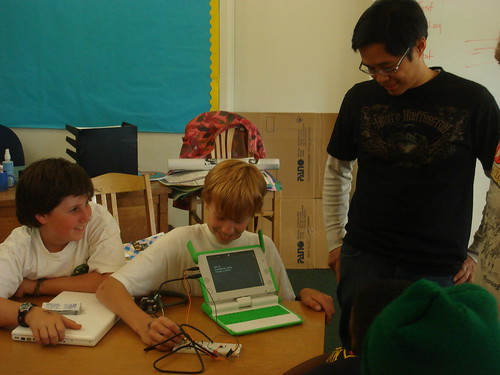
Here's a few photos from the day's lessons.


Thanks again to Kassie for getting involved with us.

Wednesday, June 4, 2008

Bay Area Pilot

On May 29, our lesson plan was delivered to 7th grade students at Marin County Middle School through two one-hour classes of 15 students each. It was the last day of a three day lesson plan that was kicked off by Kassie. Overall the lesson was well received, and I tried to insert as much adjacent application (Lie Detector) and pop culture (Wii Fit) references to maintain the students' attention and explain the phenomena.

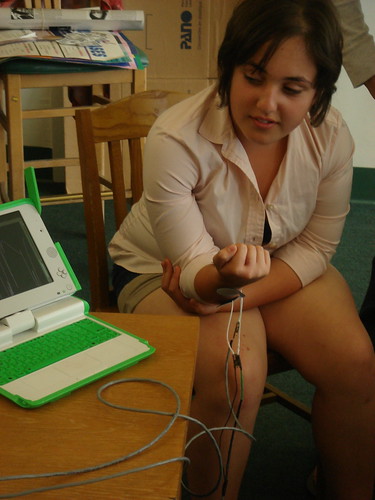
I led the day's lesson with the IR prototype and introduced the plethysmograph concept by relating it to childhood curiousity of covering the flashlight with a hand. I also digressed and talked about communications applications for IR. The IR prototype lacked an enclosure, so the readings were susceptible to motion artifacts which was an excellent lead into the the high fidelity ECG approach. While students were hooked up to the ECG circuit, the valsava maneuver was an excellent way to demonstrate the physiological effects. The students were really captivated by the signal activity and were exploring ways to induce a higher heart rate such as embarrassment. Here the lie detector concept hooked the entire class; however, it led to a few inappropriate and personal questions but we're dealing with 7th graders after all =)

Worksheets were used the previous day for the manual pulse-feel exercises. This would be a good idea for the devices introduction if more prototypes and XOs were available for the class. For the day we only had 2 ECG prototypes, 1IR prototype, and 2 XOs which was sufficient for explanation purposes but not enough to allow everyone an opportunity to get hands-on with the devices.

We'll be releasing the IR circuit schematic with a BOM soon for those interested in incorporating some biofeedback into their XO/Sugar applications.

Tuesday, May 27, 2008

Bay Area Pilot

Luckily a Marin County Middle School teacher has contacted us to participate in our very first launch of our prototype . Kassie Petrick has graciously offered us her support in the development of a lesson plan incorporating our biomedical prototypes. The lesson plan will begin with a basic introduction to the human body and then lead into a history lesson on the discovery of "vital signs". Afterwards, students will participate in manual exercises of pulse monitoring (via stethoscope and wrist/neck) and then an explanation of "lub-dub" will follow to describe the anatomy of the heart. Finally an electrical perspective of the heart's contraction will provide background for the autonomous methods ECG and Pulse Monitor (Plethysmograph) circuits. The lesson plan will be delivered to Kassie's 7th and 8th grade students and I'll be present to assist as well as monitor the kids' reception of the activity/capability. Hopefully a few students would be interested in pursuing developing a science project/health related project around this peripheral. The XO chapter of the lesson plan will be delivered on May 29th.

Lesson plan to be posted on our Google groups:
http://groups.google.com/group/olpcgoldenstate

Saturday, March 29, 2008

Initial Project Development Thoughts

First pilot program established under DSIL/Supsattana foundation. In March 2007, 30 XOs were given to a school in Samkha village located in the suburbs of northern Thailand. In this particular pilot, general feedback was provided from their basic interactions with Sugar and a few of the applications. Ban Samkha's challenge will be the structure of a constructionist curriculum that can integrate the XO effectively.
http://wiki.laptop.org/go/OLPC_Thailand/Ban_Samkha/trial-200705

Two pilot programs initiated under the support of Her Royal Highness Princess Maha Chakri Sirindhorn. As per the Princess's request, 100 XOs were deployed to two non-constructionist schools in Nakhon Nayok (suburbs of Bangkok). Students from Grades 4 and 5 participated and discussion of out-of-classroom activities began. Instructors and students would like to study the conditions of their local rivers.
http://groups.google.com/group/olpc-thailand/web/20071201-nakhon-nayok-schools

Both sites would be excellent candidates to launch our preliminary prototypes. The primary focus on these pilots would be education rather than social impact. Given the age range of these pilots it would be a steep learning curve, but we can re-evaluate the situation once the children vest their interests.

Bangkok - Ashoka Youth Venture
http://ashoka.org/youthventure
A partnership with Ashoka could provide an excellent opportunity to see the merits of the XO platform with an older student group. Also with Youth Venture's focus on youth and the community we can inspire youth to think about entrepreneurship in the context of creating social benefit. With the XO's mobility and intuitive interfaces, we can create a level playing field, both an easy ability to access the environment and low barriers to participation. Access which is a key element of the OLPC project meshes resonates well with the goals of Youth Venture. Ashoka also has a wealth of Fellow mentorship resources, specifically in the field of Health.

"Health Ashoka Fellows will not be the scientists seeking cures in the laboratories, or
even the clinical practitioners seeking to deliver inoculations and care. Rather, Ashoka Fellows will identify and develop low-cost yet high-impact strategies to deliver health care, educate populations to prevent the spread of disease, and incorporate into society populations previously excluded by the shame associated with their disability. The overlap between poverty and poor public health is well-established. Many Ashoka Fellows have not only recognized that their region cannot afford an individual-care models, but have launched alternative models of self- and community-care."
Youth Venture has a structured process that includes project selection panels, seed funding allocations, continual fellow mentorship, and workshops for the youth. We must initiate discussions with the Health fellows and perform some needs assessments to develop specific applications that can address some of the health-related issues.

We also need to identify a local school partner to introduce our activity and get preliminary Human Computer Interaction feedback.

Monday, March 10, 2008

OLPC Thailand

So why choose OLPC Thailand as the target for the health pilot? Due to my relationship with the Thai Physicians Association of America (TPAA), I have a few physician contacts throughout Thailand . Also, Thailand was one of the first countries to vest in OLPC pilot programs so they've established a pretty supportive ecosystem. Currently, there are 3 major working groups:

POLICY TEAM
1. The policy team, led by Dr. Djitt Laowattana, as an advisor to the Minister of ICT, works on the government support system and budgetary provision

COORDINATION/LEARNING TEAM
2. Lampang Province Non-Formal Education Department let by Dr.Suchin Phetcharak
3. DSIL is another coordinator involved in XO deployment

TECHNICAL TEAM
4. National Electronics and Computer Technology Center, NECTEC is the local tech contact point
5. King Mongkut’s University of Technology Thonburi, KMUTT is also assisting NECTEC
6. OLPC Cambridge offers basic deployment support

According to DSIL, this is how it all started...

DSIL, Darunsikkhalai School for Innovative Learning (http://e-school.kmutt.ac.th) is a participant in the OLPC Thailand effort. It is a K-12 school, located in southwestern Bangkok on the main campus of a technology-focused university, King Mongkut’s University of Technology Thonburi (KMUTT). DSIL is based on the constructionist theory of learning (invented by Prof.Seymour Papert of MIT's Media Lab), which focuses on concepts such as learner-centered learning, project-based learning, learning-by-doing, which aim to develop the students into life-long learners. (More info on Constructionism here) There are three multi-age classes that periodically work on projects that extend over 10-week cycles.

The school was established in 2001 through funding by two major foundations: Suksapattana Foundation (started by MIT alums in Thailand) and Thaicom Foundation. Both founders of the school were also MIT alumni. One of the founders, Khun Paron Israsena, was the CEO of the Siam Cement Group and had a close relationship with MIT Media Lab. As a result, he was invited to participate in the OLPC effort by MIT Prof. Negroponte. Khun Paron then introduced Negroponte to ex-PM, Dr. Thaksin. After a few demos, Dr. Thaksin was very impressed and decided to join the effort. Pending the success of the pilot programs, Thaksin made the diplomatic promise that Thailand would buy the first lot of at least 250,000 units. At the time, Negroponte aimed to secure at least 4 million units sold since such volume would allow the XO to be sold at USD $100. Dr. Thanksin also reassured Negroponte that he could convince neighboring countries to buy; however, Thaksin's promises soon materialized after the coup-de-tat in December 2006. After the coup, the project was immediately rejected by the provisional military government due to Thaksin's affiliation despite the merits.

Despite these political barriers, there are 3 pilot programs in progress. DSIL distributed the first 30 units to one of its school-members in the northern part of Bangkok. Reports are occasionally fed back to Cambridge to alert them of any technical issues and to shape further application development.

More details later...

Links to OLPC Thailand:
http://groups.google.com/group/olpc-thailand
http://wiki.laptop.org/go/OLPC_Thailand